
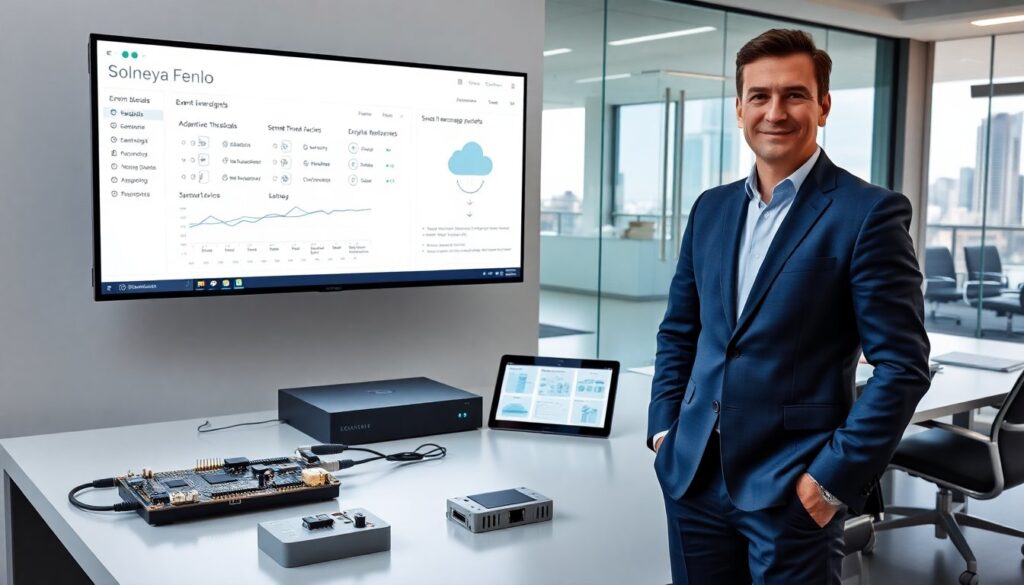
Solneya Fenlo is a hybrid sensing protocol that links environmental inputs with adaptive control. Researchers developed Solneya Fenlo to improve energy use and data accuracy. The protocol uses lightweight models and event-based signals. This introduction sets context and prepares the reader for clear, practical descriptions of Solneya Fenlo, its mechanisms, its uses, and its risks.
Key Takeaways
- Solneya Fenlo is a hybrid sensing protocol that improves energy efficiency and data accuracy by linking environmental inputs with adaptive control.
- The protocol uses edge processing with event-driven sampling to lower latency, conserve bandwidth, and extend device battery life.
- Solneya Fenlo is widely used in HVAC, agriculture, manufacturing, and utilities to provide faster local control and reduce cloud data costs.
- Implementing Solneya Fenlo requires careful threshold tuning, encryption of the event broker, and planning for firmware updates to ensure security and reliability.
- Organizations benefit from Solneya Fenlo through clearer alerts, lower operational expenses, and longer device lifespans.
- Troubleshooting focuses on balancing event sensitivity to avoid missed triggers or excess data traffic while monitoring network and firmware performance.
What Is Solneya Fenlo? A Clear, Practical Definition
Solneya Fenlo is a protocol that collects sensor data and adjusts device behavior in real time. It combines edge processing with sparse cloud updates. Engineers designed Solneya Fenlo to lower latency and conserve bandwidth. The protocol supports modular sensors and a simple message format. Developers can carry out Solneya Fenlo on microcontrollers and gateways. End users gain faster responses and lower operating costs when devices run Solneya Fenlo.
Origins, Scientific Basis, And Key Components
A university lab first proposed Solneya Fenlo in 2022. The team published experimental results on event-driven sampling and adaptive thresholds. The scientific basis rests on signal sparsity and control theory. Key components include a local inference engine, an event broker, and a sync protocol. The local engine filters raw data. The event broker routes concise messages. The sync protocol resolves state across devices and cloud services.
Core Mechanisms: How Solneya Fenlo Actually Works
Solneya Fenlo samples only when signals cross adaptive thresholds. A local model evaluates incoming values and triggers events. The device then packages a short message and sends it to the broker. The broker applies simple rules and forwards commands to actuators or cloud services. The cloud performs occasional model updates and global coordination. This flow reduces continuous streaming and preserves battery life on edge devices.
Practical Uses And Main Benefits For Users
Facilities use Solneya Fenlo to control HVAC with fine-grain feedback. Farmers use Solneya Fenlo for irrigation decisions based on soil-event triggers. Manufacturers use Solneya Fenlo to spot equipment drift before failures. The main benefits include lower data costs, faster local action, and longer device life. Organizations see reduced cloud bills when they adopt Solneya Fenlo. Users also see clearer, actionable alerts instead of raw data streams.
Real-World Use Cases: Who Uses Solneya Fenlo And Why
A municipal water utility used Solneya Fenlo to detect leaks with event thresholds and saved on telemetry costs. A greenhouse operator used Solneya Fenlo to trigger misters only when humidity dropped below a set point and improved crop yield. A logistics firm used Solneya Fenlo to reduce GPS reporting and extend battery life in trackers. Each user selects Solneya Fenlo for lower cost and faster local control.
Implementation, Safety, And Cost Considerations
Teams carry out Solneya Fenlo on low-power hardware and open-source stacks. They must test threshold settings to avoid missed events. They must secure the message broker with encryption and access control. They must plan for firmware updates from the cloud. Initial deployment costs include sensors, gateways, and engineering time. Over time, Solneya Fenlo typically reduces operational expenses by lowering data and power consumption.
Troubleshooting And Common Challenges To Watch For
Teams may set thresholds too wide and miss critical events. Teams may set thresholds too narrow and create excess traffic. They must balance sensitivity and data volume. Network jitter can delay sync messages and cause temporary state mismatch. Firmware bugs can block local inference engines and stop event generation. Teams should run staged rollouts and monitor both event rates and missed-event indicators when they use Solneya Fenlo.